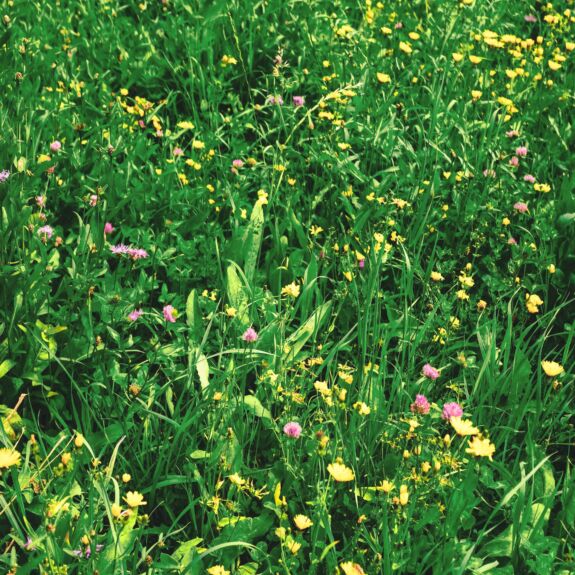
Here is a list of weeds along with information to help you diagnose your lawn.
Wood sorrel
Description and time of appearance
Perennial plant with distinct heart-shaped leaves and small yellow flowers. Late June and July.
Preventive measures
- Aerate.
- Control insects and diseases.
- Water generously and less often.
- Seed.
Control methods
Pull up plants by hand. It is difficult to control yellow wood sorrel using conventional herbicides.
Crabgrass
Description and time of appearance
Annual grasses whose leaves are light green in early to mid-summer and burgundy in late summer. Starts early in the spring and remains until the end of the summer.
Preventive measures
- While crabgrass is producing seeds, mow short and remove clippings.
- After, mow longer.
Control methods
Pull up plants by hand and seed lawn in order to increase its density. Since crabgrass is a grass the same as lawn, it cannot be controlled using conventional herbicides.
Quack grass
Description and time of appearance
Perennial grass that spreads through an underground root system. Its leaves are light green, rough, and wide. Present throughout the season.
Preventive measures
- Quack grass plants cannot be removed by hand because if their roots are torn, other plants will grow in the lawn.
- Use balanced fertilization methods to maintain a dense lawn.
- Mow your lawn to a length of 6 to 8 cm.
- Seed abundantly.
Ground ivy
Description and time of appearance
Perennial plant with round, lobed leaves. It spreads through an above-ground root system. Its stem is square. Ground ivy produces small blue to purple flowers. Present throughout the season.
Preventive measures
Maintain lawn density through balanced fertilization and proper mowing.
Control methods
Ground ivy is difficult to control using conventional herbicides.
Dandelion
Description and time of appearance
Broad-leafed perennial plant that produces yellow flowers, then white balls containing seeds that are spread by the wind. Present throughout the growing season, but the yellow flowers appear in late spring and late summer.
Preventive measures
- Increase mowing length.
- Use fertilization to maintain good lawn density.
- Remove the flowers before the seeds disperse.
Control methods
Dandelions can be pulled up by hand (several tools used for quick and effective removal of dandelions are available in gardening and hardware stores). Be sure to remove at least 2/3 of the root system. Local applications of herbicide can also be used to control a dandelion infestation.
Broad-leaved plantain
Description and time of appearance
Perennial plant that produces large leaves and many seeds. Present throughout the season.
Preventive measures
- Aerate.
- Seed with grass seed that can resist long periods of shade.
- Check soil acidity because plantain prefers alkaline soil (pH>8).
Control methods
Pull up plants by hand. Local applications of herbicide can also be used to control a plantain infestation.
White clover
Description and time of appearance
Broad-leafed (three leaflets) perennial plant from the legume family. White clover is not considered to be a weed and more and more people add it to their lawn on purpose. Present throughout the season.
Preventive measures
- Use balanced fertilizing methods.
- Control insects and diseases.
- Seed bare patches.
Control methods
Local applications of herbicide can also be used to control a white clover infestation.
Related articles

Dog Urine Burn Spots on Lawn: Quick Repair and How to Prevent Recurrence
Learn how to quickly fix dog urine spots on your lawn and prevent them from coming back with simple and effective lawn care practices.
Yellow Lawn in Spring: 7 Common Causes in Quebec and What to Do
Find out why your lawn turns yellow in spring and learn simple fixes to address soil, water, and maintenance issues for healthier grass.