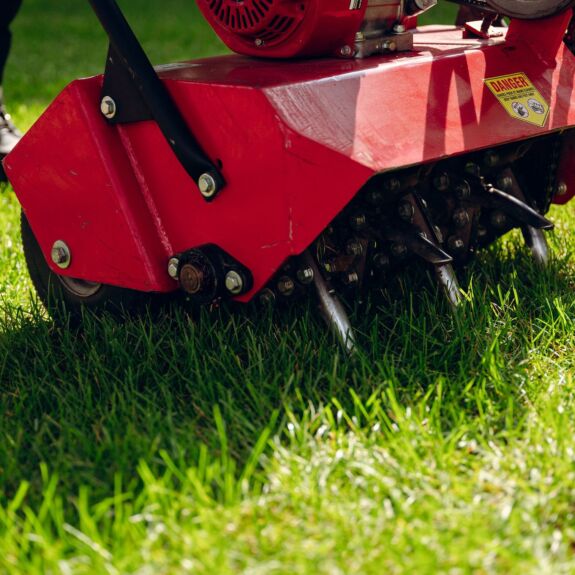
After a summer of foot traffic, mowing, kids playing, and heat waves, your soil is probably harder than it was in May. That’s normal, and more importantly, it’s fixable. Lawn aeration is the most underrated lawn care service in Québec, and fall is its best season. In this article, we explain what aeration actually changes, the signs that your soil needs it, the right timing window for your region, and why it’s worth booking now rather than in October.
What Exactly Is Core Aeration?
Lawn aeration (core aeration) uses a machine fitted with hollow tines to pull thousands of small soil cores out of the ground, 5 to 8 cm deep and about 1.5 cm across. The cores stay on the surface and break down within 2 to 3 weeks.
Spike aerators and spiked aeration sandals are also available. These tools puncture the soil but do not remove soil cores.
Is Your Soil Compacted?
No lab equipment needed, your lawn is already telling you. Here are the signs that don’t lie.
- Screwdriver test: Push a 15 cm screwdriver into slightly moist soil. If it goes in with difficulty past the first 3-4 cm, or not at all, your soil is compacted. In healthy soil, it sinks almost to the handle without forcing.
- Water pooling or running off: After a rain, puddles that sit for more than 30 minutes, or water streaming toward the driveway or street instead of soaking in, point to soil that no longer absorbs.
- Worn traffic paths: The corridors where everyone walks (to the shed, the pool, the back door) are thin or bare while the rest holds up. Foot traffic compacts, and grass gives up first where the soil is hardest.
- Shallow roots: Pull up a handful of grass. If the roots are under 5 cm, they’ve hit a wall: they can no longer grow down to reach water and nutrients.
- Thatch over 1.5 cm: Scratch the surface between the blades. A spongy brownish layer thicker than 1.5 cm between the green and the soil is excess thatch, and aeration is one of the best ways to break it up.
- The lawn yellows despite your efforts: You water, you fertilize, and the results plateau. In compacted soil, water and fertilizer sit at the surface instead of feeding the roots. Your routine isn’t the problem, the front door is closed.
Two or three of these signs together, and the diagnosis is clear: your lawn needs aeration.
What Aeration Actually Changes
Let’s be honest: holes in the lawn don’t exactly look like a premium service at first glance. Here’s what happens below the surface, though.
01. Water soaks in instead of running off.
Every core removed becomes an infiltration channel. Aerated soil can absorb water several times faster than compacted soil, which means less runoff, fewer puddles, and every watering finally reaching the roots.
02. Roots breathe and grow deeper.
Roots need oxygen as much as water. By relieving compaction, aeration opens the way down: roots go from 3-5 cm to 10-15 cm over one or two seasons. Deep roots mean a lawn that rides out a July drought instead of browning at the first heat wave.
03. Fertilization starts paying off.
Fertilizer applied to compacted soil sits on the surface and partly washes away. After aeration, it moves straight into the root zone. Same product, completely different result.
04. Thatch breaks down.
The cores left on the surface bring soil micro-organisms into contact with the thatch layer, speeding up its natural decomposition. It’s a gentle, free dethatching, included in the operation.
05. Overseeding takes twice as well.
Every aeration hole is a small shelter for seed: direct soil contact, retained moisture, protection from birds and wind. That’s why aeration and overseeding are ideally done the same day, in that order.
Why Fall Is the Best Time
Aeration can be done in spring or fall, but in Québec, fall wins for three reasons.
- The lawn is in active root growth. From late August through October, grass puts its energy into roots rather than blades. Aeration holes close within 2 to 3 weeks with fresh growth, exactly when the plant benefits most.
- Weeds are out of the race. In spring, every aeration hole is an open invitation to dandelion and crabgrass seeds germinating at that very moment. In fall, those annuals have finished their cycle: the holes benefit the grass, not the competition.
- Soil moisture is just right. Fall rains bring soil that’s neither soggy nor baked hard, the ideal condition for the tines to pull complete cores. Soil that’s too dry makes the machine bounce; soil that’s too wet compacts further under its weight.
Best Period for Aeration in Québec
The rule: aerate while the grass is still actively growing, at least 3 to 4 weeks before the first hard frost.
- Southern Québec (Montréal, Montérégie, Eastern Townships): August 20 to October 10. The golden window is all of September.
- Québec City, Mauricie, Centre-du-Québec: August 15 to September 30.
- Saguenay, Abitibi-Témiscamingue, Bas-Saint-Laurent: August 15 to September 15. Past mid-September, growth slows too much for the holes to close before winter.
A useful benchmark: as long as you’re still mowing every week, the lawn is growing enough to benefit from aeration. When mowing drops to every two weeks, the window is closing.
Why Book in August
As soon as the nights cool down, lawn care companies’ schedules fill up, and the best September dates go first. Booking in mid-August rather than late September is the difference between choosing your window and taking what’s left.
Booking early also lets you sequence services in the right order: aeration, then overseeding the same day, then fall fertilization 4 to 6 weeks later. That sequence, done in the right window, is worth more than any single treatment done at the wrong time.
How to Prepare for a Successful Aeration
01. Flag the hidden obstacles.
Têtes de gicleurs, fils de clôture invisible pour chien, câbles peu profonds : identifiez-les avec des petits drapeaux avant le passage de la machine. C’est l’étape qu’on oublie et qu’on regrette.
02. Water the day before if the soil is dry.
A 2.5 cm watering the day before (or a good rain within the previous 48 hours) gives the soil the ideal moisture for pulling complete cores.
03. Mow at normal height beforehand.
A 6-8 cm mow a few days ahead makes the job easier and prepares the ground if overseeding follows.
04. Aim for 20 to 40 holes per square metre.
C’est la densité qui donne des résultats. Sur les zones très compactées (corridors de passage), un deuxième passage perpendiculaire double l’effet.
05. Leave the cores where they fall.
Resist the urge to pick them up. They break down within 2 to 3 weeks and return their nutrients and micro-organisms to the soil. A light raking after a week can speed things up if the look bothers you.
06. Follow with overseeding and fertilization.
The same day as aeration: crosshatch seeding, then fall fertilizer. The holes do the rest of the work.
07. Water and leave it alone.
Keep the soil moist for 2 to 3 weeks, especially if you overseeded, and limit foot traffic while the holes close up.
When to Call a Professional
- You don’t have the machine, and that’s fine. A mechanical aerator weighs over 100 kg, rents by the day, and is hard to handle on slopes and in corners. For an average residential lot, the professional service often costs barely more than the rental, minus the sore back.
- Your soil is clay-heavy or severely compacted. These soils call for a well-weighted machine and sometimes two passes: the right equipment makes a real difference.
- You want the full sequence. Aeration, overseeding, and fertilization coordinated within the right window, with the right products: that’s where a lawn care expert’s work pays for itself.
- Drainage seems to be involved. If water pools even in areas with no foot traffic, the problem may go beyond compaction, and an on-site diagnosis is worth doing before you invest.
Book Your Aeration While There Is Still Places Left
At Vertdure, our experts perform core lawn aeration with professional equipment, at the right time for your region, and can pair it with overseeding and fall fertilization in the sequence that gets the most out of each service. September spots go fast: request your free quote now or explore our lawn care packages to reach spring with soil that breathes.
Related articles
Fall Lawn Checklist: 10 Tasks to Plan Starting in Late August
Prepare your lawn for winter with the right tasks at the right time. Follow a simple schedule to promote thicker, healthier grass next spring.
Year-Round Lawn Care Guide: Month-by-Month
Get a dense, green lawn year-round with our month-by-month lawn care guide, featuring seasonal tips, treatments, and expert advice.