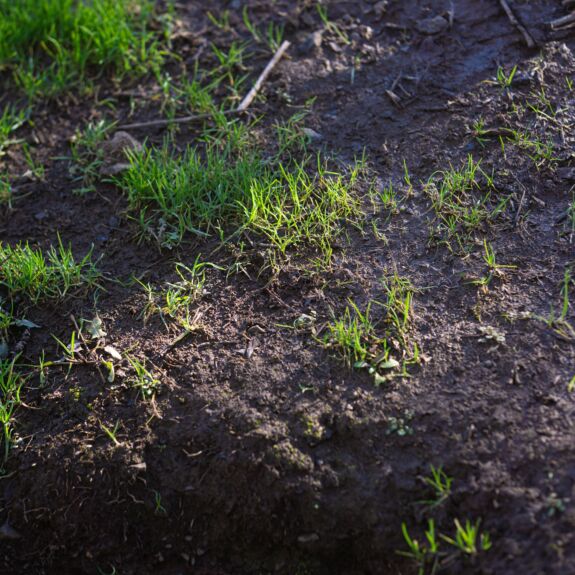
Looking at your lawn and seeing bare patches, thin spots, grass that took a beating over the summer? The best time of year to fix it is just around the corner, and it isn’t spring. In Québec, the ideal window for overseeding and lawn seeding opens in late August and closes around the end of September.
In this article, we explain why this period beats every other, how to tell whether your lawn needs it, and the concrete steps to get your seeding right the first time.
Why Late August Is Better Than Spring (By a Wide Margin)
Let’s be honest: the spring reflex is strong. The snow melts, you see the damage, you head to the hardware store for seed. Understandable, but from the grass seed’s point of view, it’s the worse of the two windows. Here’s why late August wins.
01. The soil is warm, and seed loves that.
After a full summer of sun, the soil holds between 15 and 25 °C, the ideal germination range for fescues and Kentucky bluegrass. The result: emergence in 7 to 14 days for most mixes, versus 21 days or more in spring, when the soil is barely out of the frost and struggles to climb past 10 °C.
02. Nights cool down, stress goes down.
From mid-August on, nights drop below 15 °C. Young shoots get warm days to grow without facing the July heat waves that can scorch a new seeding in 48 hours. It’s exactly the opposite of spring, where an April seeding often gets caught by June heat before it’s properly rooted.
03. Weeds are done for the season.
Dandelions, crabgrass, and most annual weeds germinate in spring and early summer. Seed in late August and your young grass grows in soil where the competition is at its lowest. A spring seeding, on the other hand, emerges at the same time as everything sitting in the soil’s seed bank, and the weeds almost always win that race.
04. Evaporation slows, so your watering works harder.
Heavier morning dew, gentler sun, soil that stays moist longer: every late-summer watering does more work than a June watering. For seed that needs to stay constantly moist for 2 to 3 weeks, that’s a huge advantage.
05. The plant gets two seasons to root.
Grass seeded in late August grows its roots through the fall, goes dormant, then restarts in spring with a head start. By the time the neighbours are just getting around to seeding, yours is already established and ready for its first summer.
Does Your Lawn Need Overseeding?
Avant de sortir l’épandeur, prenez cinq minutes pour confirmer ce que vous avez devant vous.
- Test de la densité : Regardez votre pelouse à hauteur de genou. Si vous voyez le sol entre les brins sur plus de 25 % de la surface, un sursemis s’impose. En bas de 25 %, une fertilisation d’automne peut suffire à densifier.
- Test du tirage : Tirez doucement sur une poignée de brins dans une zone faible. S’ils s’arrachent facilement avec peu de racines, le gazon est affaibli et le sursemis aidera à le renouveler.
- Plaques mortes ou clairsemées : Des zones brunes qui ne reverdissent pas après une bonne pluie sont mortes, pas en dormance. Ces plaques ne se rempliront pas seules : il faut y remettre de la semence.
- À ne pas confondre : Si les plaques mortes se détachent comme un tapis, avec des racines sectionnées en dessous, vous avez peut-être des vers blancs. Réglez ce problème avant de semer, sinon les larves mangeront les racines de votre nouveau gazon aussi.
The Best Time for Your Region
The golden rule: your seeding needs 4 to 6 weeks of growth before the first hard frost.
- Southern Québec (Montréal, Montérégie, Eastern Townships): August 15 to September 25. The golden window is the last week of August and the first week of September.
- Québec City, Mauricie, Centre-du-Québec: August 15 to September 15. Don’t push past mid-September, the first frost comes earlier.
- Saguenay, Abitibi-Témiscamingue, Bas-Saint-Laurent: August 10 to September 5. Here, late August is truly the comfortable limit, not the start of the window.
A useful benchmark: if the forecast still shows daytime highs of 20 °C or more for the next two weeks, you’re in the window. If nights are already dipping below 5 °C regularly, it’s closing.
Overseeding Step by Step
01. Mow short, once.
Drop your mowing height to 4-5 cm (instead of the usual 6-8 cm) and bag the clippings. The seed needs to touch the soil, not sit trapped in the thatch.
02. Dethatch or aerate if needed.
More than 1.5 cm of thatch? Run a dethatching rake over it. Hard, compacted soil (a screwdriver barely goes in)? Core lawn aeration right before seeding is the best investment you can make: the cores open thousands of soil-to-seed contact points.
03. Choose the right seed.
For Québec, a mix of Kentucky bluegrass, fine fescues, and perennial ryegrass gives the best balance of density, cold hardiness, and speed of emergence. Shady area? Bump up the fescue proportion. Plan on roughly 1 to 1.5 kg of seed per 100 m² for overseeding, and 2.5 to 3 kg per 100 m² for full seeding on bare soil.
04. Seed in a crosshatch.
Spread half the dose in one direction, the other half perpendicular to it. You’ll avoid visible seeding lines and missed spots.
05. Ensure contact between seeds and soil.
Run a leaf rake upside down or a light roller to press the seed against the soil. Seed floating on top of the grass won’t germinate. On bare patches, a 0.5 cm dusting of lawn soil or compost helps hold moisture.
06. Fertilize for rooting.
A phosphorus-rich starter fertilizer, applied the day you seed, supports root development. It’s the foundation for everything else.
07. Water lightly, but often.
This is where most seedings fail. For the first 2 to 3 weeks, keep the top centimetre of soil constantly moist: 1 to 2 light waterings of 5 to 10 minutes per day, ideally in the morning. A single dry day can kill a seed mid-germination. Once the grass is up, transition gradually to one deep watering of 2.5 cm per week.
08. Wait before mowing.
First mow when the new shoots reach 8-10 cm, never before, with a sharp blade, removing no more than a third of the height.
Simple 6-Week Action Plan
- Week 1 (late August): short mow, dethatching or aeration, crosshatch seeding, starter fertilizer, first watering.
- Weeks 2-3: light daily waterings, no foot traffic, no mowing. Emergence shows up between days 7 and 14.
- Week 4: first mow at 8-10 cm if the grass is ready, gradual reduction in watering.
- Weeks 5-6 (late September, early October): weekly deep watering, final fall fertilization to prepare for winter.
The least glamorous secret in this whole plan: consistent watering for the first three weeks. Everything else can be perfect, but if the seed dries out for one day, you start over.
When to Call a Professional
Some situations are worth handing off to a lawn care expert:
- More than 40 % of the area is dead or bare, and you’re torn between overseeding and a full lawn renovation.
- The soil is heavily compacted or the drainage is poor: seeding over that without fixing the base is seeding for nothing.
- You suspect white grubs or another lawn pest under the dead patches.
- You want aeration, overseeding, and fertilization combined in the right sequence, with the professional equipment that guarantees soil-to-seed contact.
- You simply aren’t available to water every day for three weeks. That’s fine, it can be planned differently.
Contact Us If You Need Any Tips
Late August doesn’t last long, and every year it’s when our schedules fill up the fastest. At Vertdure, our lawn care experts assess the real condition of your property (density, thatch, compaction, insects) and carry out aeration, overseeding, and fall fertilization in the right sequence, with professional-grade equipment. Request your free quote or explore our packages to give your lawn the head start that late summer offers.
Related articles
Patchy Lawn: What to Do Before Overseeding
Before overseeding a sparse lawn, learn the key steps to fix soil, thatch, and maintenance issues for stronger and longer-lasting grass recovery.
Best Grasses to Plant in Quebec
Having a luscious green lawn in Quebec can be challenging due to the harsh winters. Find out which cool-season grasses are best for your lawn!