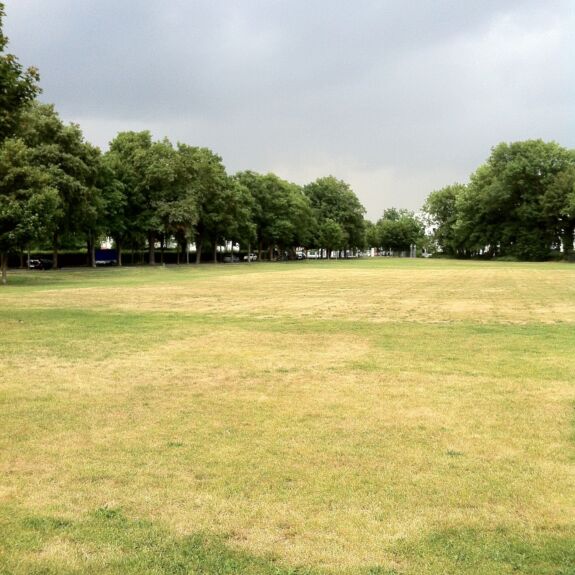
It has rained, sometimes a lot, and yet your lawn is turning yellow. It is confusing. We instinctively link a yellow lawn to a lack of water, so when water is not the issue, it is hard to know what to think. The good news? When a lawn yellows despite the rain, it is almost never a watering problem, and the cause can usually be diagnosed by eye.
In this article, we go through the most common causes of a yellow lawn in summer when water is not to blame, how to tell them apart, and what to do in each case.
First, analyse the pattern of the yellowing
Before blaming a cause, look at how the yellow shows up. The pattern is your best clue:
- Uniform yellow across the whole lawn: often a matter of nutrition (leached nitrogen) or mowing.
- Irregular patches or circles: think fungal disease or white grubs.
- Yellow concentrated in dips and low areas: excess water and poor drainage.
- Small yellow spots ringed with darker green: animal urine.
- Spongy or very hard turf underfoot: thick thatch or compacted soil.
Run two quick tests as well:
- The tug test: gently pull on a yellowed tuft. If it lifts up like a piece of carpet, the roots have been severed, which points to white grubs.
- The screwdriver test: push a screwdriver into the soil. If it strongly resists, your soil is compacted.
The good news is that a yellow lawn is almost never a lost cause. In the vast majority of cases, you can identify the problem and fix it.
The most common causes of a yellow lawn despite the rain
01. White Grubs
- Signs: yellow patches that keep spreading, turf that lifts like a carpet. Birds, skunks, or raccoons digging up the soil at night.
- Why: the larvae of June beetles and chafers feed on the roots in late summer. With no roots, the grass yellows and dies even when it rains, simply because it can no longer take up water.
- What to do: lift a 30 cm x 30 cm section of turf and count the larvae. Above 5 to 10, you have crossed the intervention threshold. A targeted treatment at the right time (nematodes or a professional product) followed by reseeding the dead patches usually solves it.
02. Fungal Diseases Driven by Moisture
- Signs: brownish-yellow patches or circles, sometimes with a darker ring around the edge. A fine white, grey or pink thread (mycelium) visible in the morning dew.
- Why: heat + prolonged humidity + foliage that stays wet overnight is the perfect setting for fungi like brown patch or red thread. Here, the rain does not heal the lawn, it is part of the problem.
- What to do: water in the morning and never in the evening, avoid excess nitrogen in the heat, improve air circulation, and collect the clippings while a disease is active. A professional diagnosis can confirm exactly which fungus is at work.
Let's be honest: watching your lawn yellow after a week of rain is frustrating. But it is usually the sign of a specific, fixable cause, not a lawn that needs to be redone.
03. Nitrogen Leached by the Rain
- Signs: a pale, uniform yellowing across the whole lawn, which still keeps growing.
- Why: heavy rain washes nitrogen (the nutrient that gives grass its green) below the root zone. The lawn pales from a lack of food, not a lack of water.
- What to do: a fertilization suited to summer, without overdoing it. A balanced application at the right time usually brings the colour back within 1 to 2 weeks.
04. Excess Water and Poor Drainage
- Signs: yellow concentrated in dips and low areas, soggy soil, a stagnant earthy smell, sometimes visible moss.
- Why: waterlogged soil starves the roots of oxygen. They suffocate, and the grass yellows even when there is no shortage of water, precisely because there is too much of it.
- What to do: let the soil dry out between rain events, fix the spots that hold water (levelling, drainage), and consider lawn aeration to open up the soil.
05. Compacted Soil
- Signs: hard soil, water that runs off or pools on the surface instead of soaking in, and thin grass in high-traffic areas.
- Why: packed soil keeps water, air, and nutrients from reaching the roots. The result: rain runs off without benefiting the lawn, which stays yellow and weak.
- What to do: lawn aeration (core aeration) loosens the soil and restarts root growth. It is often followed by overseeding to thicken the lawn.
06. Thatch That Is Too Thick
- Signs: spongy, springy turf underfoot that dries out quickly on the surface even after rain.
- Why: a layer of thatch thicker than 1.5 to 2 cm acts like a sponge at the surface. Water sits in it, the roots develop within it instead of reaching the soil, and the lawn yellows at the slightest stress.
- What to do: dethatching, followed by aeration to rebalance things. Avoid excess nitrogen, which thickens thatch over time.
07. Mowing Too Short or with a Dull Blade
- Signs: yellowing that appears right after mowing, with frayed, whitish tips.
- Why: cutting too low (scalping) or with a dull blade stresses the lawn and tears the blades, which brown the tips. Rain makes no difference here.
- What to do: raise your cutting height to 8 to 10 cm in summer, sharpen the blade 1 to 2 times per season, and never cut more than one-third of the blade in a single mow.
Handy reference points
Problem thatch
More than 1.5 to 2 cm.
White grub intervention threshold
More than 5 to 10 larvae per 30 cm x 30 cm.
Summer mowing height
8 to 10 cm.
Watering
In the morning, never in the evening, to limit disease.
Colour returning after fertilization
1 to 2 weeks.
A simple action plan
- Read the pattern (uniform, patches, dips, spots) and run the tug and screwdriver tests.
- Rule out the obvious first: mowing too short, a dull blade, a recent and poorly dosed fertilization.
- If the turf lifts like a carpet, check for white grubs.
- If you see circles or mycelium: suspect a disease, switch to morning watering, and ease off the nitrogen.
- If water is pooling: let it dry, then plan aeration and, if needed, a drainage correction.
- Once the cause is fixed, reseed the dead patches through overseeding to restore a dense lawn.
When to call a professional
- Patches spread quickly or the turf lifts easily (likely white grubs).
- Disease-like circles or spots keep coming back despite your efforts.
- Water stays pooled for a long time or the soil is heavily compacted.
- The yellowing persists despite proper fertilization and mowing.
- You would rather have a precise diagnosis than try one product after another without knowing what you are treating.
FAQ
Why is my lawn turning yellow when it has been raining a lot?
Because the problem is not the water. The most common causes are white grubs, a fungal disease, excess water that suffocates the roots, or nitrogen leached out by the rain.
Can too much rain make grass turn yellow?
Yes. Waterlogged soil starves the roots of oxygen, rain carries nitrogen out of the roots' reach, and prolonged moisture encourages disease. Excess water is a real cause of yellowing.
How do I tell white grubs from a disease?
Do the tug test. If the lawn lifts like a carpet, it is probably white grubs. If it stays firmly anchored but shows circles or a fine mycelium in the morning, lean toward a fungal disease.
At Vertdure
A lawn that yellows despite the rain almost always hides a specific cause: white grubs, disease, compacted soil, thick thatch, or a nitrogen deficiency. At Vertdure, our experts assess your property on site to pinpoint the real cause and recommend the right complementary services: lawn aeration, overseeding, fertilization, and insect and weed control. Get a free quote or explore our lawn care packages to bring back a green, healthy lawn.
Related articles

Mowing During a Heatwave: The Right Cutting Height for a Quebec Summer
Avoid cutting your lawn too short during hot weather. Discover our tips for keeping your lawn healthy despite the heat wave.
Watering in the Morning or Evening: What Is Really the Best Time?
Improve your lawn’s health with simple tips on the best watering time, proper frequency, and key practices to keep grass green and resilient.