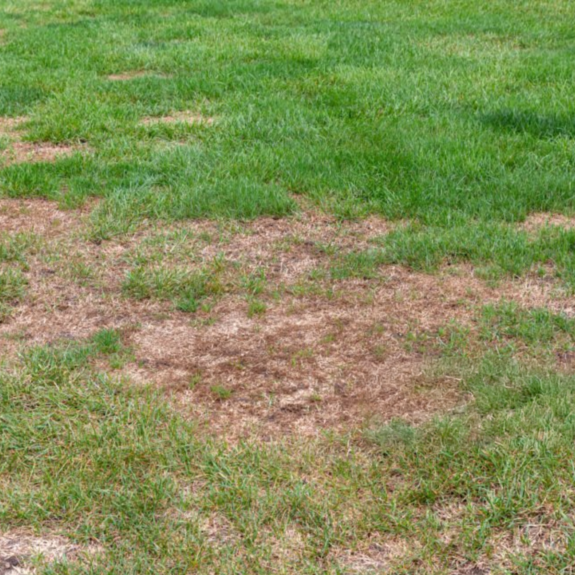
Several causes may be behind your yellow patches. Here is a list with information to help you diagnose your lawn.
Bluegrass Billbug
Symptoms and Time of Appearance
Yellow patches that are 10 cm or more in diameter. Mid-July to late July.
Organism responsible
The bluegrass billbug is a grey-black insect, 7 to 8 mm long. Its larvae are white, legless and have a brown head.
Detection
Grass does not regain its green colour after watering and the blades break when pulled.
Preventive measures
- Increase the mowing length (6-8 cm).
- Aerate.
- Seed the damaged patches.
Control methods
There is no insecticide available and approved under Quebec law for dealing with the bluegrass billbug. The only way to control this pest is to use the appropriate lawn care methods.
Dog urine
Symptoms
Appearance of circles that are 10 to 20 cm in diameter that are dark green at first then turn yellow. Dog urine causes grass to turn yellow because it is very rich in ammonia.
Detection
Some patches of grass remain yellow in the spring while the rest of the lawn has already turned green.
Preventive measures
- Keep dogs off your lawn or restrict their access to a given area (perhaps covered in rock dust) where they can relieve themselves.
- Water the grass in order to mask the most severely damaged areas, then reseed.
Frost
Symptoms and Time of Appearance
Irregular yellow patches ranging in size from a few centimeters to several meters in diameter. Early spring.
Detection
Some patches of grass remain yellow in the spring while the rest of the lawn has already turned green.
Preventive measures
- Leave the grass longer when you mow to promote deeper root development.
- Water for longer periods but less frequently to foster deeper root development.
- Reseed damaged areas.
White grubs
Symptoms and Time of Appearance
Irregular patches of yellow grass that can reach up to a meter in diameter and sometimes even more. Lawn torn up by skunks that like to feed on the grubs. April-May and late August to early September.
Organism responsible
White grubs are the larvae of the June beetle.
Detection
The grass is no longer fastened to the soil and can be pulled out easily. Presence of white, "C"-shaped larvae (1 to 5 cm long).
Preventive measures
- Increase the mowing length (6-8 cm)
- Aerate.
- Seed the damaged patches.
Control methods
Apply nematodes (microscopic worms that attack white grubs) in mid-August when the soil temperature is adequate. After applying the nematodes, water generously to allow them to penetrate the soil. An insecticide that is very effective against white grubs is available. Contact your local Vertdure branch.
Lack of water
Symptoms and Time of Appearance
Grass turns yellow over nearly its entire surface. During heat waves and in droughts (most commonly in July).
Detection
Grass turns yellow and doesn't straighten after being walked on. Note that Kentucky bluegrass goes dormant when under stress. This allows it to survive these types of conditions. It is not in danger, because it will return to its normal appearance after the rain returns.
Preventive measures
- Increase the mowing height or do not mow it at all during these periods.
- Water for longer periods but less frequently to foster deeper root development.
Hairy chinch bug
Symptoms and Time of Appearance
Yellow patches that are 10 cm or more in diameter. Mid-July to late July.
Organism responsible
The hairy chinch bug is a small insect (< 3mm) that feeds on sap from the grass.
Detection
Présence de dizaines de punaises velues (rouge orangé) près des tiges de gazon. Les plaques de gazon jaune s’agrandissent même à la suite d’un arrosage.
Preventive measures
- Increase the mowing length (6-8 cm).
- Aerate.
- Seed the damaged patches.
Control methods
When the chinch bugs are present during the month of July, apply insecticide soap in the morning or evening. Repeat this treatment one week later. In case of a major infestation, contact your local Vertdure branch.
Webworm (Cranberry Girdler)
Symptoms and Time of Appearance
Irregular yellow patches ranging in size from a few centimetres to several meters in diameter. September or October.
Organism responsible
The webworm is a small white butterfly that zigzags over the lawn when disturbed. The butterflies themselves do not damage the lawn and are present from late June until late August. The beige larvae are about 2 cm long and are responsible for damaging the lawn.
Detection
Grass can be pulled out easily. Presence of beige larvae on the ground.
Preventive measures
- Aerate.
- Seed the damaged patches.
Control methods
Some insecticides can be used to control webworms. Contact your local Vertdure branch for more information.
Dollar spots
Symptoms and Time of Appearance
Yellow patches 7 to 13 cm in diameter. Early summer and then again in the late summer/early fall.
Organism responsible
Disease called “dollar spots”.
Preventive measures
- Increase the mowing length (6-8 cm).
- Aerate.
- Water generously in the early morning (between 5:00 a.m. and 8:00 a.m.).